
Are your students ready for Kindergarten?


Good Dental Health Leads to Better Overall Health
- Tooth decay is the most common chronic disease in children.
- Children with poor dental health are three times more likely to miss school because of dental problems.
Have you heard?
Michigan passed a new law to ensure children entering kindergarten have a dental assessment prior to starting school. The Kindergarten Oral Health Assessment Program (KOHA) aims to improve school readiness and raise awareness of the importance of good oral health. My Community Dental Centers in partnership with [Health Department Name] is provide assessments in conjunction with back to school events at the school and in other community locations.
What should schools do?
- Notify parents about KOHA by providing information in KOHA forms and parent letters. We have a communication toolkit ready for you here [link] to encourage family participation!
- Communicate the importance of dental health and encourage parents to ensure their children receive a free oral health assessment by October 31.
- Compile and submit recommended school assessment data to MDHHS by November 1 of each year beginning with the 2023-2024 school year. Assessment data is collected in Section V of the MDHHS 3305 Health Appraisal form. (see QR code below)
We can help!
My Community Dental Centers in partnership with [Health Department Name] is providing assessments in conjunction with back-to-school events.
Invite us to KOHA/Hearing Vision clinics, Kindergarten Roundup, or other community events.
Partner toolkit
- Detroit
FAQ
Dental cavities are the #1 most common chronic childhood illness and cavities can cause pain. Cavities can prevent kids from eating and can keep Kids awake at night and both eating and sleep help kids learn. It is important to screen kids for health issues before they start school so if they do have cavities, then the cavities can be fixed and the kids will be well-rested, able to eat, and ready to learn!
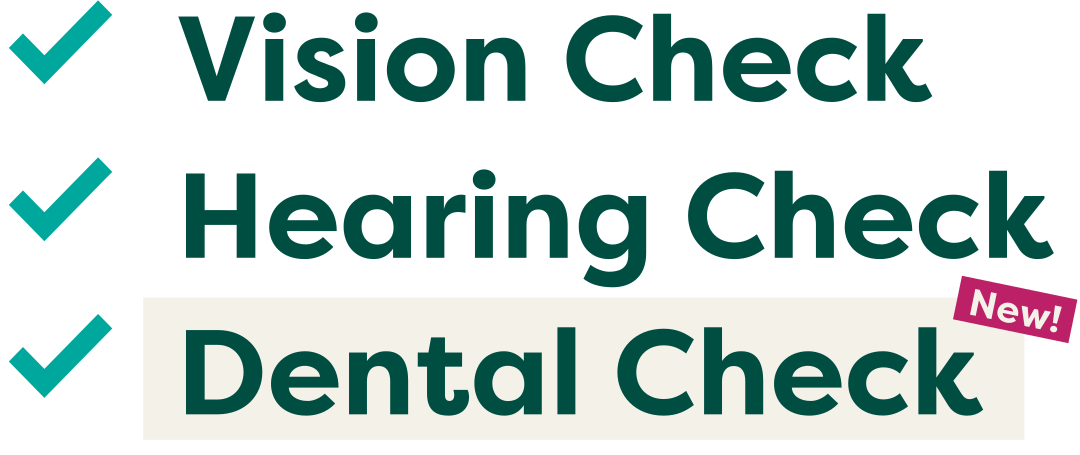
Yes, It is Michigan law that students are also screened for hearing and vision, and these are done to make sure students can see and hear in the classroom, so they are able to learn.
This law is specifically for students entering Kindergarten, but it is highly recommended that all kids see a dentist at least once a year.
The school will give you a KOHA 6067 Form. The form will need to be completed by professionals, such as a dental therapist or dentist.
This is language specific to dental providers, a dentist completes a dental exam, and dental hygienists/dental therapists will complete a dental assessment. You only need to have one dental provider complete the screening.
If you learn your student has a cavity or cavities, they will need to have the cavities filled. A cavity does not stop growing on its own, it will need to be treated by a dentist. The person who completes your student’s dental screening will be able to help with appointments for follow up care.
Any dentist, dental therapist or registered dental hygienist licensed in Michigan can complete the form.
A dental therapist is a newer type of provider allowed in Michigan, so they are included under the new law. However, at this time they are not many dental therapists, so you will more than likely have your student seen by a dentist or a dental hygienist.
Contact your Local Health Department for help finding a dental provider to do the screening. The school nurse or secretary may also be able to help. The school staff members are aware of this law and will know who to contact in your community for help.
There are a variety of ways to have kids in Michigan seen by a dentist or dental professional. Consider enrolling in the Michigan’s Health Kids Dental Program and contacting your Local Health Department for help finding a dental home. Michigan’s Healthy Kid Dental Program: Healthy Kids Dental Program (michigan.gov)
Pre-schoolers- Can be seen no earlier than March 1st prior to the start of their Kindergarten school year.
Kindergarteners- All Kindergarteners are eligible for KOHA starting March 1st-the last day of the Kindergarten school year.
1st Grade- If a child enters the school system directly into 1st grade, they will also need an assessment completed.
Young 5’s- Not considered as eligible by MDHHS until March 1st (same as pre-school requirement)
